After traveling by boat across the English Channel from Southampton (England) to La Harve (France), they remained in reserve for several days at the Infantry Base Depot as they prepared to be reassigned to their new units. It was essentially a massive sorting center. Supplies, weaponry, food, and manpower all had to be categorized, inventoried and moved onwards to the right place. The journey from La Havre to the Western Front was a long one and the men were exhausted even before they arrived at the front lines.
They had boarded a train at Montvillers Station at night before beginning the long journey towards northern France. Their train traveled east across Normandy to Abbeville, following the coastline towards the north through Boulogne and Calais towards the Belgian Border. From here they traveled inland, going south-east, through St. Omer and Hazelbrook, eventually arriving in Ballieul. They marched from Ballieul towards the front lines where they met their fellow soldiers in their reserve camp.
“Arrived at their billets in time for supper”. – September 4th, 1915
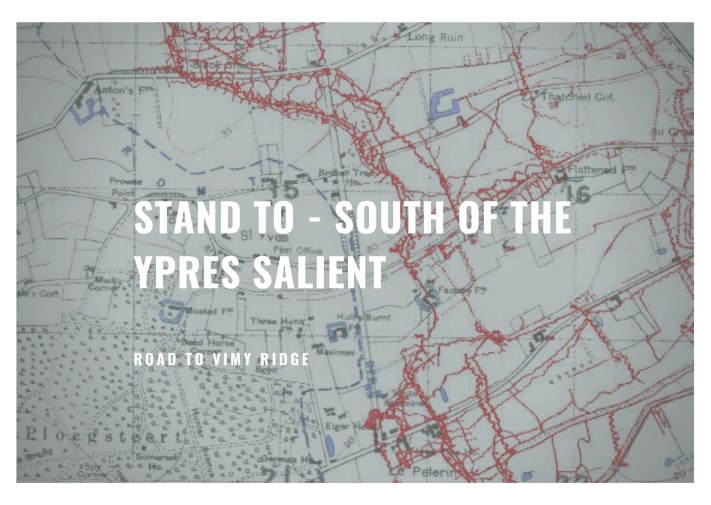
Whatever excitement they gained from their arrival was short-lived and shortly after supper (dinner) they were sent directly to the front lines. The Canadian HQ was located in France and their trenches a few kilometers across the border in Belgium.
“Was put in M.G. section right away and went to trenches with a full pack (to be remedied).”
Arrived in trenches after a long muddy walk about 9pm. Was on duty until about 10:30 and went into dugout to try and sleep, did not get much. Germans very quiet only fired a few shots-both sides.” – September 4th, 1915

The Front Line Trenches
By the end of 1914, the two armies had reached a stalemate in Western Europe and the soldiers had dug into defensive positions. An interconnected network of trenches stretched from the North Sea to the Swiss Alps, separating the German and Allied (British and French) armies. It would become known as the Western Front.
Behind the front lines were huts and camps set up for soldiers that were in reserve. On September 4th, Percy began his journey towards the front lines.
The soldiers approached the trenches from the rear, through the communication trenches which connected with all the other forward positions. On their way to the front, they passed other soldiers who were on their way back to the reserve.
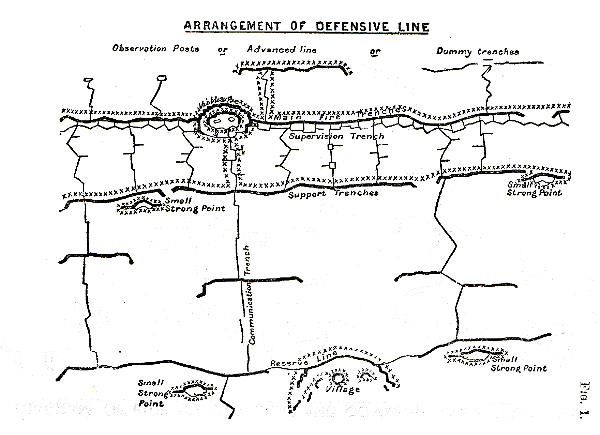
They traveled under the cover of darkness to avoid detection of the enemy. Carrying full packs, they hunched over as they marched, the heavy bags weighing down their every step into the thick mud. The sound of machine-gun fire or artillery explosions echoed in the distance. The trench system had become well established and the organization of the lines was quite the feat of engineering.
There were different layers or stages that they would encounter along the way. First would be the Reserve Line, where you would find dugouts cut into the sides of the trench walls to offer some shelter from the rain. They were quite small, but if would offer space for 3 or 4 soldiers to sleep. The support lines was where you would find Platoon or Company Headquarters and telephone positions for signalers.
They would next come up to the Support Line, where men in sections would remain prepared for an attack.
The final stage was the Front Line or Firing Line. Percy was a private in a Machine Gun unit, and when on duty, this is where he would have spent his time. Communication trenches linked the rear areas with both lines, and it was along these that all men, equipment and supplies had to be fetched, by hand.
“Arrived in trenches after a long muddy walk about 9pm. Was on duty until about 10:30 and went into dugout to try and sleep, did not get much. Germans very quiet only fired a few shots-both sides.” – September 4th, 1915
Despite being exhausted, Percy didn’t sleep much on that first night. In a little over 24 hours, they had been transported from the Coastal comforts of La Havre to the harsh reality of the front lines. Welcome to the Western Front. There wasn’t much that could prepare someone to experience something of this magnitude.
The darkness of the night would soon be replaced with the bleakness of the day.
“Stand to”
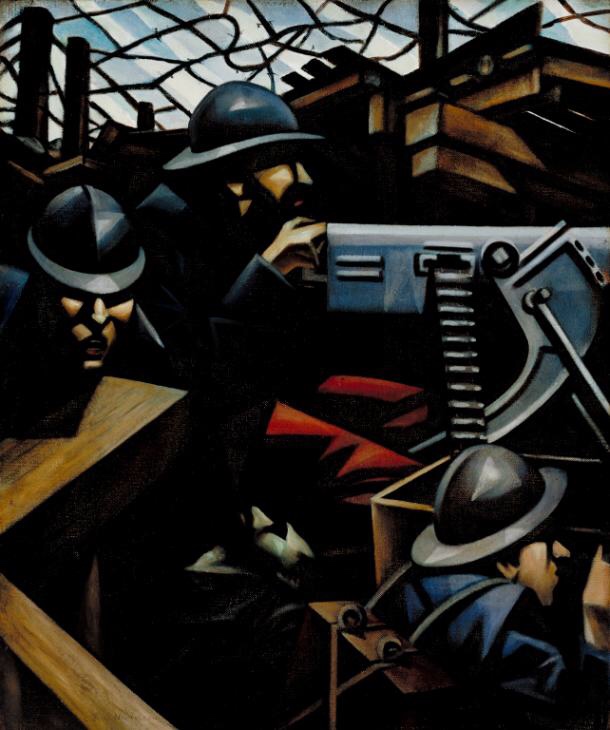
Thirty minutes before sunrise, they were instructed to get into position. The order to ‘stand to’ was relayed along the front line, the instruction silently whispered to the soldiers ordering them to be prepared. Most attacks would happen at dawn or dusk, either first thing in the morning or right before dark, as the strange light would give a slight advantage to the attacking soldiers.
Tension quickly rose amongst the men. Stand to was the official start to the soldiers’ routine. It was also lovingly referred to as the Morning Hate.
“Stood to at approximately 4am.” – September 4th, 1915
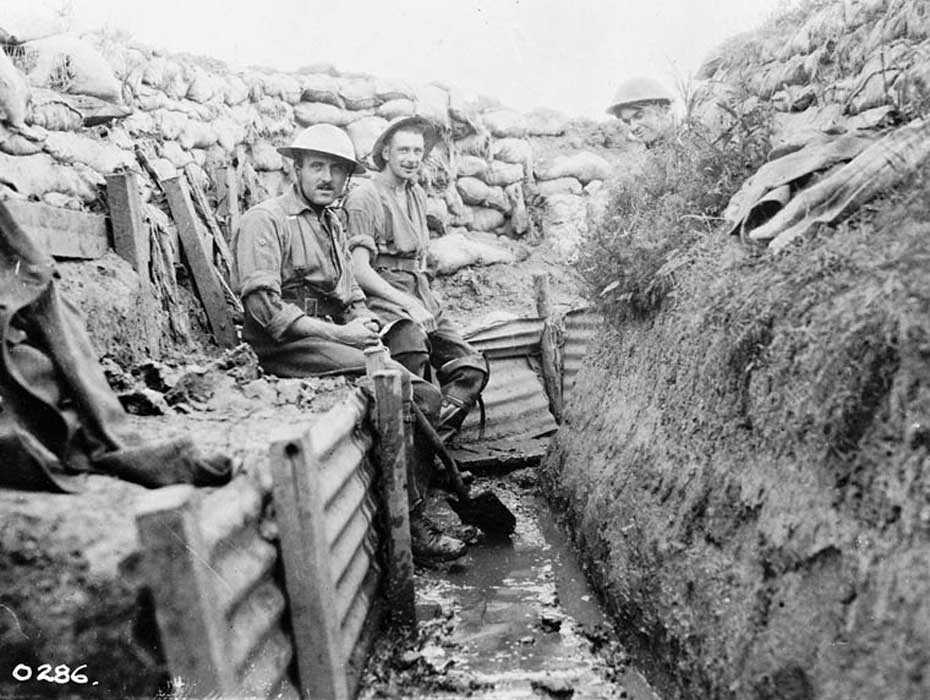
Stand to was the shortened form of ‘Stand-to-Arms’, which meant the soldiers needed to be on high-alert for an enemy attack. It seemed like a silly ritual, as both sides observed the same routine. Before the break of day, they would climb up to the platform known as the fire step in order to be prepared to repel any raids by the enemy. Men would fix bayonets and were prepared to strike back at an attack.
Percy climbed up to his position, where his units Colt Machine gun was loaded and overlooking the battlefield and he got his first look at No Man’s Land. It was foggy so he couldn’t see the opposing side but the battlefield clearly showed signs of war. As his eyes glanced around the battlefield he couldn’t find the words to describe what he was looking at. He was quick to pull his head back into a safe position, as he had seen enough for one morning.
The routine of firing off into the distance became known as the “Morning Hate”. After “Stand to”, they were given their daily rum ration and began their daily routine…
“Exchanged a few shots each side just as it was getting light.” – September 4th, 1915
Sources:
- Percy’s War Journal [Primary Source – Canadian War Museum]
- Library and Archives of Canada [via www.canada.ca]
- Map of Bailleul, Kemmel, and Ploegsteert via the Online Library of UPEN [digital.library.upenn.edu]
- Trench Map [via www.royalmontrealregiment.com]
- Trench Diagram [via www.nps.gov]
 Road to Vimy Ridge